Direct answer
What you need to know
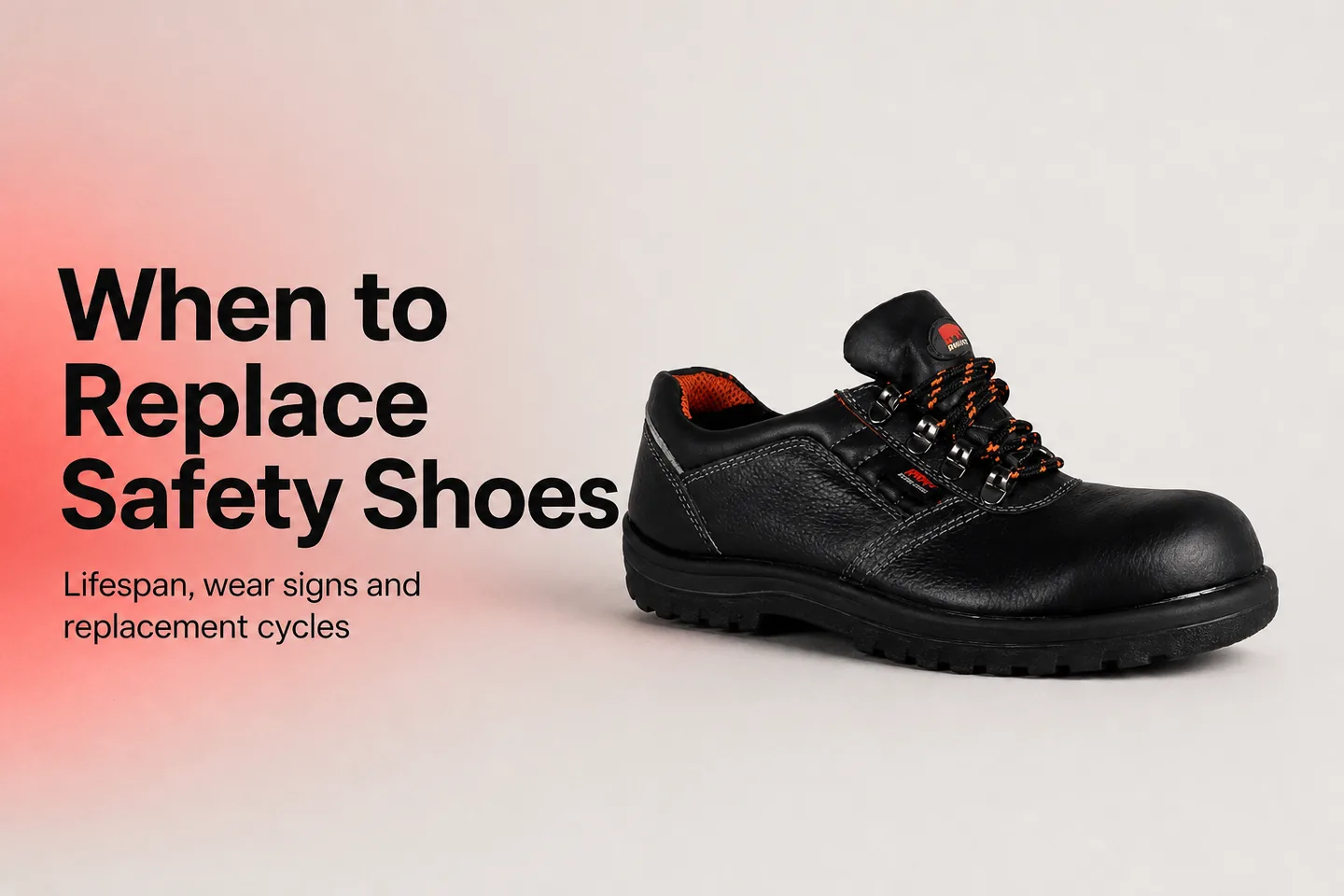
Safety shoes have no printed expiry date. Expect replacement every 6 to 12 months of daily use (3 to 6 months in heavy construction, up to 24 months in light indoor work), or immediately after a visible wear sign, an impact or a puncture. In Malaysia the employer must pay for the replacement under OSHA 1994 s.26.
A safety shoe does not carry a printed expiry date, but it does have a service life. With daily use in a normal industrial environment, expect to replace a pair every 6 to 12 months. Heavier construction or field work can shorten that to 3 to 6 months, while light indoor use may stretch it to 12 to 24 months. Industry guidance also points to roughly 1,500 km of wear under average usage, which for a worker on their feet all day is about one year. The safest rule is simpler than any of these numbers: replace the shoe when a visible sign of wear appears, and replace it immediately once it has absorbed an impact or a puncture.
This guide covers how to judge the life of a safety shoe, what Malaysian law says about who pays for the replacement, and a monthly check you can put into your site routine.
There is no single expiry date
Lifespan depends on four variables that change from one site to the next:
- Frequency of use — a pair worn every shift wears out far faster than a spare kept for emergencies.
- Working environment — abrasion, dust, chemicals, heat and wet floors all attack the sole and upper in different ways.
- Contact with substances — oils, solvents and acids can degrade compounds that look fine on the surface.
- Quality and maintenance — better materials and consistent cleaning slow the decline, but they never stop it.
Even when a shoe still looks serviceable, the materials that provide the protection degrade with time and repeated flexing. A common industry baseline is to replace safety footwear every six months of daily use, then adjust up or down with the checklist below.
Typical replacement intervals by working conditions
Use the table as a planning baseline for procurement and budgeting. The intervals assume the shoe is worn daily and maintained normally.
Working conditions | Typical interval (daily use) | Main driver |
|---|---|---|
Light indoor work — offices, warehouses, light assembly | 12 to 24 months | Low abrasion, clean, dry environment |
Regular industrial work — manufacturing, maintenance, logistics | 6 to 12 months | Constant flexing, abrasion, general exposure |
Heavy construction or field work | 3 to 6 months | Aggressive surfaces, impact loading, chemical contact |
Any use after a damaging impact or puncture | Immediate | The protective event has already been absorbed |
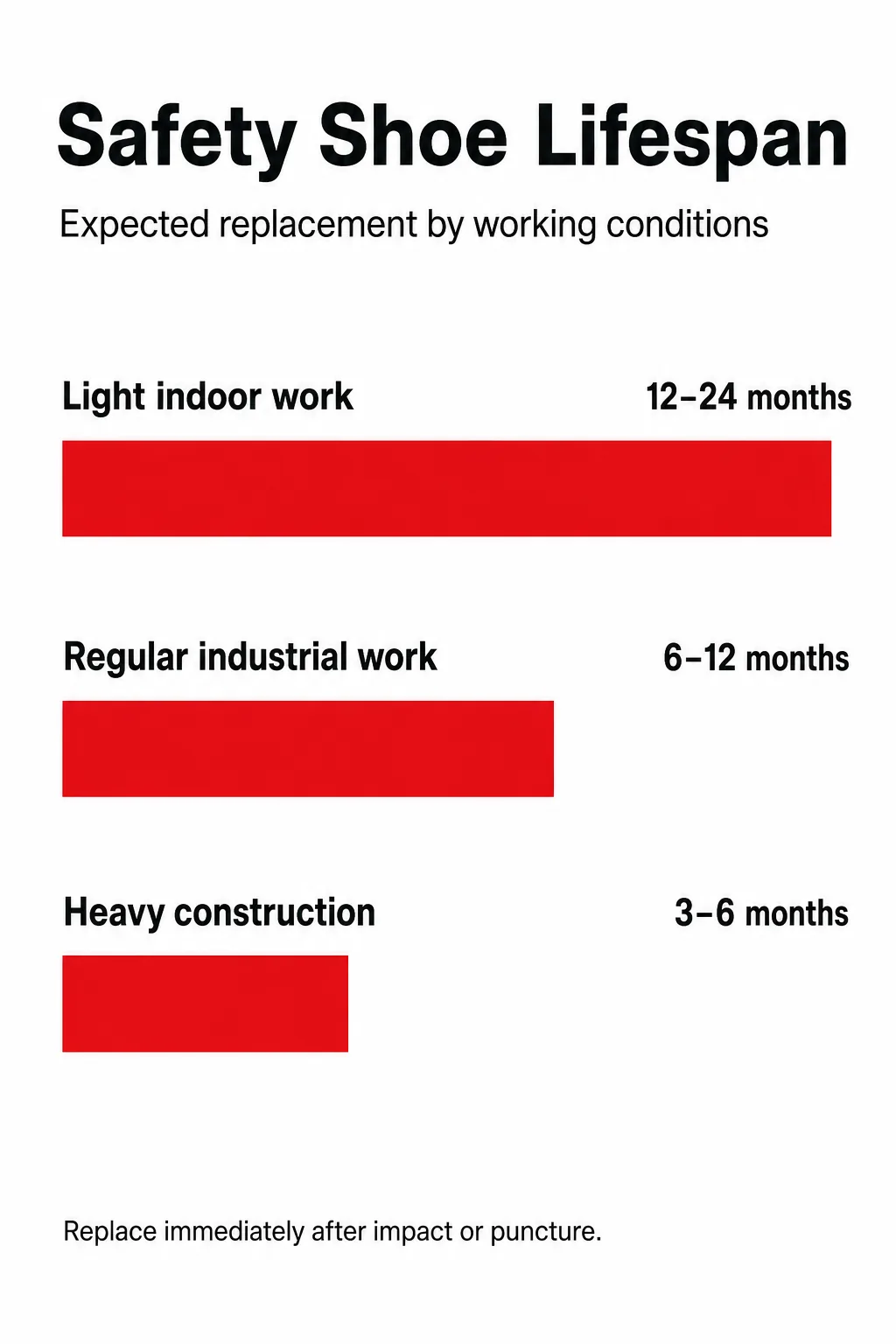
Two practical notes. First, a warehouse worker's shoes can be expected to outlast a construction worker's under the same schedule — the environment does most of the damage. Second, the intervals above are the shoe's life, not its warranty. Budget the replacement cycle into your PPE plan rather than waiting for the pair to fail.
Five wear signs that mean it is time
Wear inspection matters more than the calendar. Check these five areas on a regular schedule:
Part | What to check | Replace when |
|---|---|---|
Outsole and tread | Tread depth, cracks, chunks of sole material, embedded debris | Tread worn flat, sole cracking or breaking away |
Sole-to-upper bond | Perimeter glue line, flexing or lifting at the heel and toe | Sole lifting, separating or visibly moving |
Toe cap and upper | Pressure marks, tears, stretched leather or textile, visible cap | Upper split, cap exposed or deformed after impact |
Insole and cushioning | Compression, flattening, foot fatigue at the end of a shift | Cushioning flat, persistent foot or ankle pain |
Waterproofing, where specified | Seepage after rain, washdown or wet work | Water reaching the foot through a water-resistant shoe |
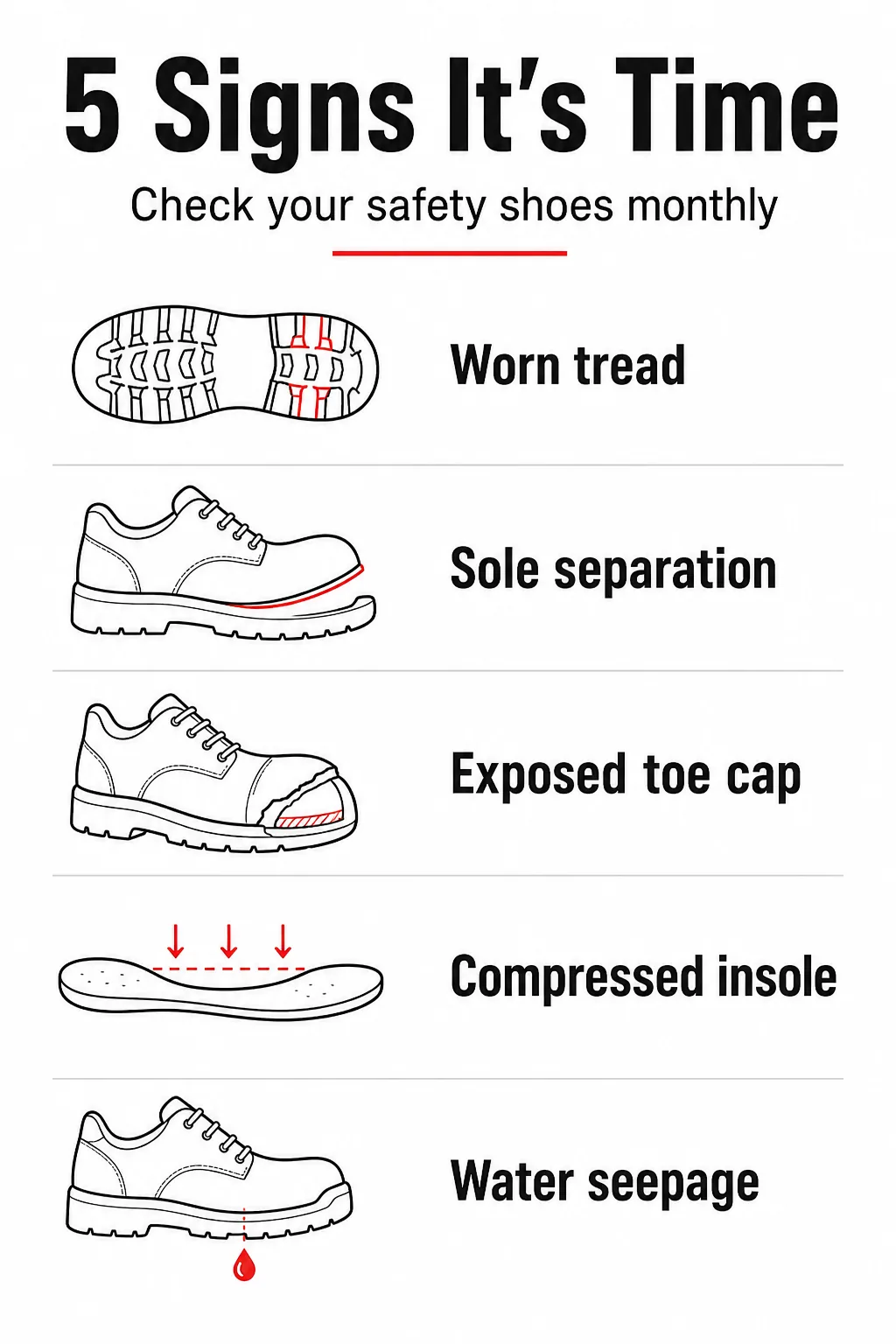
If any answer in that table is yes, the pair has done its job and should come off. Do not attempt to restore a failing bond or a damaged cap with adhesive or a cobbler's repair: the certified protection level no longer applies to a modified shoe.
After an impact or a puncture, replace immediately
A safety toe cap is designed to absorb one major event. Once it has taken a crushing impact, even without a visible dent, its ability to protect again is compromised. The same applies to a puncture-resistant sole: a spike or nail that has penetrated it has permanently changed the shoe's protective status.
The worker should report the incident, the pair should be withdrawn from service, and a replacement issued before the worker returns to the hazard. This is also a record-keeping moment — an impact or puncture event belongs in the site's safety notes, not just in the bin.
Who pays for replacement in Malaysia?
Under section 26 of the Occupational Safety and Health Act 1994, an employer must not charge employees for things done or provided in carrying out the Act. Safety footwear supplied as required protective equipment is part of that duty, so the cost of regular replacement falls on the employer, not the worker.
The companion duty sits with the employee: under section 24, an employee must use protective equipment or clothing that is supplied to them. Both sides have a role — the employer provides and replaces on a sensible cycle, and the worker wears, looks after and reports the condition of the equipment.
Failure to provide the required protective equipment can carry a fine of up to RM500,000 and up to two years' imprisonment under the Act, so a documented replacement cycle is good practice for the business as well as the worker.
If your group operates in more than one country, the rules differ. In the United States, for example, OSHA 29 CFR 1917.96(f) generally requires employers to pay for replacement PPE except where the employee loses it or intentionally damages it, while 29 CFR 1926.95 permits non-specialty safety-toe footwear to be employee-paid in construction. Wherever the site is, put the local rule in writing in your PPE procedure.
Extending the life of the shoes you already have
- Clean the outsole regularly. Tread buried in dust, sand or chemical residue slips more and wears faster.
- Dry properly after wet work. A damp interior degrades adhesives and lining, and causes the odour that masks other wear.
- Rotate pairs where shifts allow. Two pairs sharing the hours last longer than one pair working daily.
- Store off the floor where possible — away from sun, heat sources and chemicals stored on site.
- Do the wear inspection monthly and record it. The pair that is failing usually shows signs weeks before it fails.
A simple monthly replacement checklist
- Tread depth still present across the outsole
- Sole fully bonded — no lifting at heel or toe
- Upper intact, no exposed or deformed toe cap
- Insole still cushioning, no end-of-shift foot pain
- Waterproofing holding, where the model is rated for wet work
- No impact or puncture event since last check
All six pass means keep the pair. Any fail means the shoe should come off before the next shift.
Frequently asked questions
Do safety shoes have an expiry date?
Not a printed one. The service life is driven by use and environment, and a common planning baseline is 6 to 12 months of daily wear, adjusted by the working conditions and by visible wear.
How often should a manufacturing worker replace safety shoes?
In a typical factory environment, 6 to 12 months of daily use is the realistic band. Abrasive floors, chemical contact or hot surfaces will pull the pair toward the lower end, so check the five wear signs monthly rather than relying on the calendar alone.
Can worn safety shoes be resoled or repaired?
Resoling a general-purpose pair may extend comfort, but a safety shoe that has failed a wear check, or has taken an impact or a puncture, should not be repaired and reused — its certified protection no longer applies. Replace it.
Who pays for replacement in Malaysia?
The employer. Section 26 of the Occupational Safety and Health Act 1994 prohibits charging employees for protective equipment required by the Act, and section 24 requires employees to use the equipment supplied to them.
Put a replacement cycle into your PPE procedure
If you want the right starting point for your site, RHINO SHOE's technical team can recommend models by hazard profile — including DOSH–SIRIM approved options for Malaysian tenders and the trade-offs in steel and composite toe caps. Contact us and we will help you build the replacement schedule for your site.
Safety footwear must be selected through a workplace risk assessment. Standards, certification and DOSH–SIRIM approval are model-specific; confirm current documentation before procurement.