Direct answer
What you need to know
ESD footwear is designed to help protect electrostatic-sensitive devices within a controlled system, while antistatic safety footwear primarily reduces charge accumulation and limits certain shock risks for the wearer. ESD shoes are generally within a narrower resistance range and must be used with compatible flooring and testing procedures.
In electronics and semiconductor facilities, “antistatic” and “ESD” are often used as if they mean the same thing. They do not.
Antistatic footwear focuses on controlled charge dissipation
Antistatic safety footwear is designed to reduce electrostatic build-up while maintaining a level of resistance between the foot and ground. Under common EN ISO 20345 concepts, the antistatic range is broader than the ESD range.
This helps manage risks associated with static discharge and ignition in some environments, but it does not make the footwear suitable for live electrical work. Antistatic footwear is not electrically insulating footwear.
ESD footwear protects sensitive processes and components
ESD footwear is used as part of an electrostatic protected area. Its electrical resistance is controlled within a narrower range associated with ESD programmes, commonly referenced through IEC/EN 61340 requirements. The purpose is to move charge to ground in a controlled way before it can damage sensitive components.
The shoe cannot do this alone. ESD performance depends on the person, sock, insole, footwear, flooring, grounding path, humidity and maintenance condition working together.
Why tropical conditions still require testing
Malaysia, Singapore, Thailand, the Philippines, Vietnam and Indonesia often have high ambient humidity, but air-conditioned production areas can create very different conditions. Sweat, contamination, worn soles and unauthorised replacement insoles may also change electrical resistance.
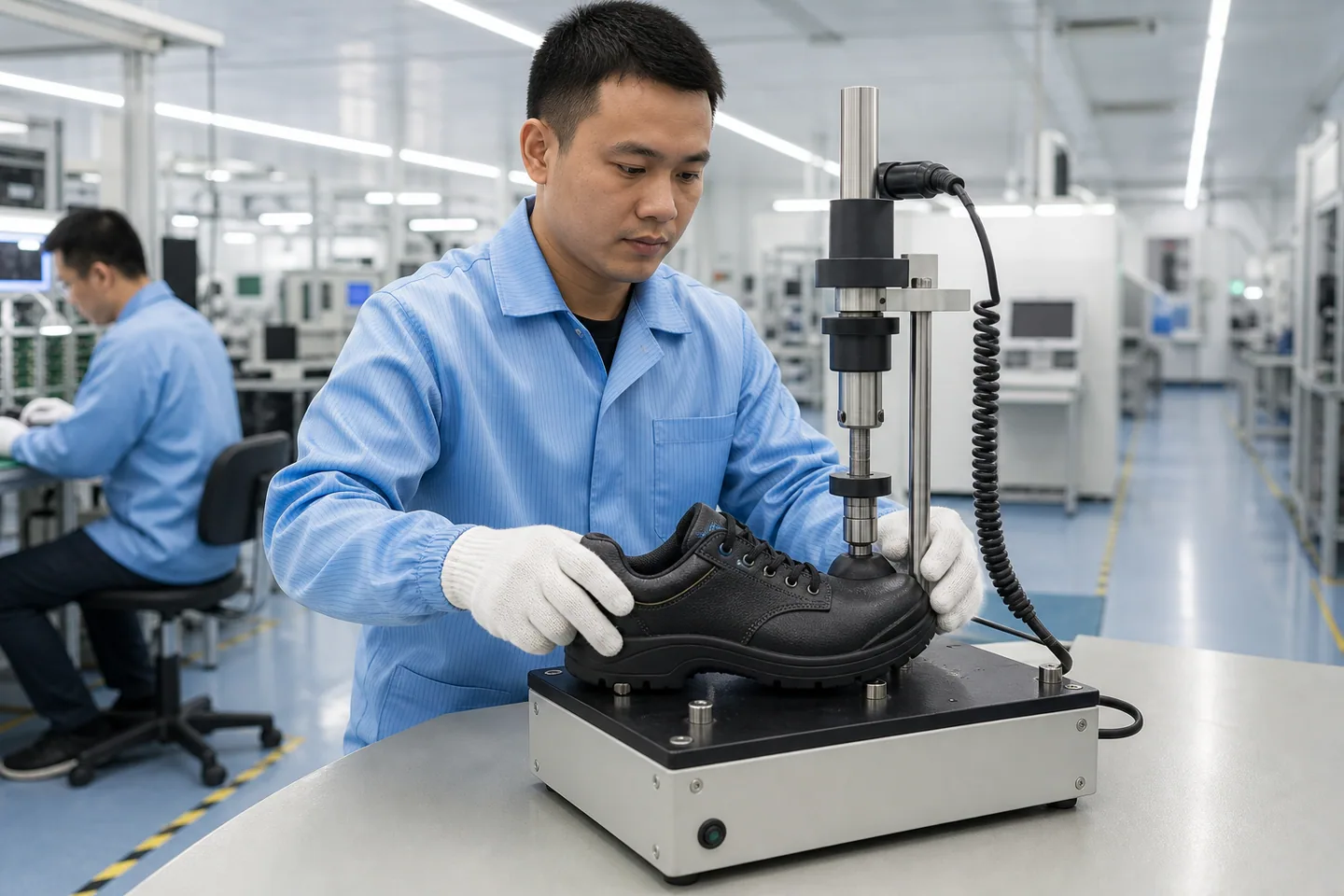
That is why electronics plants normally test the person-footwear-floor system at defined intervals rather than assuming that an ESD logo guarantees continuing performance.
Five controls for an ESD footwear programme
- Specify the required electrical-resistance range and test method.
- Pair footwear with compatible ESD flooring.
- Control socks and replacement insoles.
- Test wearers before entry where the ESD programme requires it.
- Clean footwear using approved methods and replace damaged pairs.
What about toe protection and slip resistance?
ESD is only one property. An electronics plant may still need 200-joule toe protection, puncture resistance, slip performance, low particle shedding, metal-free construction or a washable upper. Select the complete certified model against all hazards.
RHINO SHOE offers footwear intended for electronics and controlled manufacturing environments. Buyers should request the exact model's technical data and confirm compatibility with the facility's ESD control plan. For Singapore workplace-safety support, see Safetyware Singapore.
Safety footwear must be selected through a workplace risk assessment. Standards, certification and DOSH–SIRIM approval are model-specific; confirm current documentation before procurement.